

From Stardust to Soil: Why Chelated Micronutrients Are the Rock Stars of Plant Nutrition


At Glee last year, we had a little fun with one of the biggest ideas in plant nutrition. We presented micronutrients as the “Rock Stars” of healthy plant growth.
It was a memorable theme, but it was not just a play on words. The mineral elements plants depend on have a remarkable story. All of the elements found in rocks were formed through processes associated with earlier generations of stars. Those elements became part of the material that formed the Earth and, eventually, the soils in which plants grow.
You can see how we brought the idea to life in our Glee 2025 leaflet.
The fascinating part is that having a mineral present in the soil does not necessarily mean a plant can use it. Some mineral compounds are soluble, but many are not readily available to roots. That is where biology and chemistry come together, and it is where chelation becomes so important.
Key Takeaways
- Chelated micronutrients help improve nutrient availability, making essential mineral elements more accessible to plants.
- Micronutrients matter alongside NPK, as a deficiency in one essential element can limit plant growth and performance.
- Soil and plant analysis can help identify nutrient gaps, allowing growers to take a more targeted approach to plant nutrition.
- The S-Chelate Plant Nutrition range includes single-element products, micronutrient packages and complete feeds for different crops and growing systems.
- Chelated nutrition can work alongside soil biology, supporting organic, regenerative, horticultural and amenity approaches to plant and soil health.
Did you know? All of the mineral elements plants depend on today have origins stretching back to processes inside earlier generations of stars. Which of plant nutrition’s “Rock Stars” plays the biggest role in your growing system?
From rocks to roots
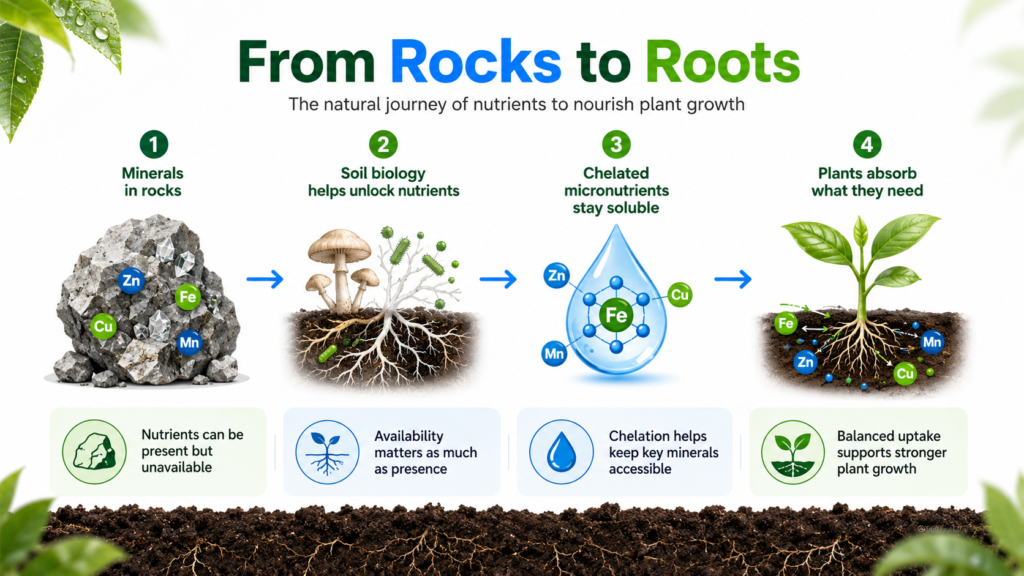
Plants need a surprisingly broad range of mineral elements to grow well. Nitrogen, phosphorus and potassium may get most of the attention, but micronutrients such as iron, manganese, zinc, copper, boron and molybdenum are also essential.
The challenge is availability.
A soil may contain plenty of a particular element, yet that element can still be effectively unavailable to the plant because it is locked into an insoluble mineral form or affected by soil pH and chemistry.
Nature has been solving this problem for a very long time. Fungi, bacteria and plant roots release organic compounds that help mobilise mineral nutrients. Mycorrhizal fungi are especially important because their fine hyphae can explore soil beyond the immediate root zone, helping plants gain access to water and nutrients that would otherwise be difficult to reach.
This natural process is one of the reasons chelation matters so much. A chelate binds to a mineral ion and helps keep it in a soluble form, making it more available to the plant.
That is the principle behind S-Chelate technology. Our aim is to provide essential mineral nutrition in a form that is both highly soluble and biologically friendly.
Why micronutrients deserve more attention
Micronutrients are only required in small amounts, but “small” does not mean “unimportant”.
Magnesium, for example, is central to chlorophyll. Iron is involved in chlorophyll formation and electron transport. Zinc, manganese, copper, boron and molybdenum all play important roles in plant metabolism, enzyme systems, reproductive growth and nutrient use.
This is where Liebig’s Law of the Minimum becomes useful. Plant growth is limited not by the total amount of nutrients present, but by the essential nutrient that is in shortest effective supply.
In practical terms, a crop can have access to plenty of nitrogen, phosphorus and potassium but still fail to perform if one key micronutrient is deficient or unavailable.
That is why we see micronutrients as part of a balanced nutrition strategy, not as an optional extra.
S-Chelates are designed to help plants make better use of the wider nutrition already present in the growing system. In organic and regenerative systems, that can mean complementing composts, manures and other sources of macronutrients with targeted micronutrient inputs.
One range, different nutrient needs
There is no single feed that is right for every soil, crop or growing system. That is why the S-Chelate product range includes single-element products, formulated micronutrient packages and complete plant feeds.
A grower with a confirmed iron deficiency needs a different solution from a crop requiring broader micronutrient support. Likewise, a tomato grower may have different nutritional priorities from a golf course manager looking after intensively managed turf.
Our Groundswell 2025 leaflet sets out the full product range, elemental contents and application rates in an easy-to-reference format.
| Product group | Examples | Best suited to |
| Single-element S-Chelate-O products | Boron, Copper, Iron, Magnesium, Manganese, Zinc | Targeting identified nutrient deficiencies |
| Multi-element micronutrient packages | M Squared, IPM Assist, Super-7, Cultiv-8 | Broader micronutrient support |
| Regenerative products | S-Chelate Ca, S-Chelate Ca Plus, S-Chelate Activ-8 | Biologically friendly nutrition within regenerative systems |
| Complete feeds | S-Chelate 12 Star, S-Chelate Protom | Supplying macro and micronutrients together |
This flexibility matters because better plant nutrition starts with understanding what is actually missing.
Test first, then target the gaps
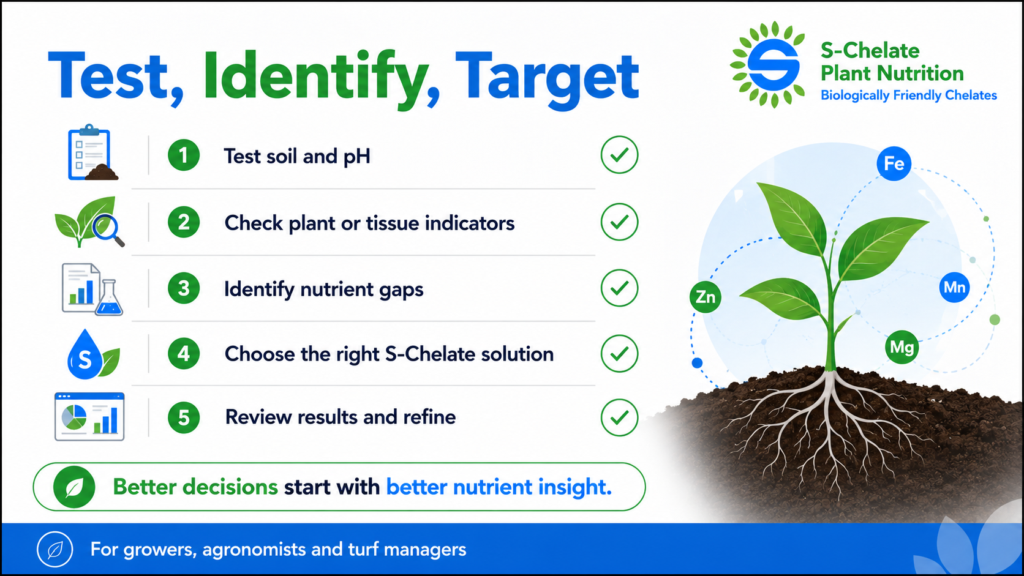
For organic and regenerative growers, soil analysis is an important part of making nutrient decisions.
Testing can help identify nutrient levels, pH and other factors that influence availability. In some situations, tissue or leaf analysis can also help show what the plant is actually taking up.
Once a deficiency or imbalance has been identified, a targeted product can be selected to fill the gap.
That approach can help growers:
- avoid applying nutrients that are not needed;
- focus on elements that may be limiting plant performance;
- complement composts, manures and other nutrient sources already being used;
- make more precise and evidence-led fertility decisions; and
- build a nutrition programme around the actual needs of the soil and crop.
A number of products in our S-Chelate-O range are Soil Association approved for organic growing, including single-element products and formulated micronutrient combinations such as S-Chelate-O Cultiv-8.
Cultiv-8: supporting the nutrition already in the system
S-Chelate-O Cultiv-8 is a good example of how micronutrients can work alongside existing fertility.
It contains eight essential biologically friendly chelated micronutrients and is designed to complement sources of macronutrients such as organic composts.
That makes it particularly relevant where growers are already supplying nitrogen, phosphorus and potassium through compost, manure or other fertiliser inputs but want to address the micronutrient side of the equation.
Because the product is a completely water-soluble powder concentrate, it can be diluted for use as part of an established feeding programme.
The important point is not simply that Cultiv-8 contains eight micronutrients. It is that those elements are supplied in a chelated form designed to improve their availability to the plant.
Complete nutrition with 12 Star and Protom
Sometimes growers need more than a micronutrient package.
S-Chelate 12 Star is a complete feed formulated with essential micronutrients and macronutrients, making it suitable where a more complete nutritional input is required.
S-Chelate Protom applies the same broad principle specifically to tomatoes. It is formulated with micronutrients and macronutrients and was developed to reduce the risk of blossom end rot.
We have also carried out practical trials with these products. Our work includes avocado growth comparisons, basil trials using S-Chelate 12 Star and S-Chelate-O Fe, and the development of Protom for tomatoes.
You can read more about our work with tomatoes in the S-Chelate Protom blossom end rot trial.
From farms to fairways
The same principles of nutrient availability and soil biology apply well beyond food production.
In agriculture, our distributor Soil Ecology Laboratory combines soil and plant analysis with expertise in soil biology and composting. This makes S-Chelate products part of a wider regenerative approach in which growers can assess the condition of the soil, identify nutrient gaps and then make more targeted decisions.
In the amenity sector, Soil Biology works with golf courses, sports turf and other managed surfaces. Its work focuses on supporting the soil biome and helping turf managers move towards more biologically based management.
Healthy, biologically active soils can contribute to better structure, nutrient cycling and resilience. Soil Biology also highlights the importance of a diverse soil ecosystem in helping turf cope with pressures such as drought, flooding and disease.
Our Groundswell 2025 article explains more about how these agricultural and amenity partnerships fit into the wider S-Chelate Plant Nutrition approach.
Living Feed: bringing nutrition and biology together
Living Feed is another example of this joined-up thinking.
It combines S-Chelate micronutrients with living microbiology, bringing mineral nutrition and biological inputs together in one product. It also contains macronutrients, organic amino acids and fulvic acid.
For growers interested in regenerative or biology-led approaches, that combination is particularly relevant. It reflects the idea that mineral nutrition does not need to sit separately from soil biology. The two can be used together as part of a wider strategy for plant and soil health.
More information is available on our Living Feed product page.
Why the “Rock Star” idea still matters
The “Rock Star” theme works because it connects a much bigger scientific story with a very practical growing challenge.
The elements plants need have ancient origins, but the question facing growers today is simple: are those elements actually available to the plant when it needs them?
That is where chelation has a valuable role to play.
By keeping essential mineral nutrients soluble and available, S-Chelates can help growers address deficiencies, complement existing macronutrient sources and build more balanced feeding programmes.
For organic growers, regenerative farmers, horticultural businesses and turf managers alike, the principle is the same:
- test where appropriate;
- identify the limiting nutrient;
- use the right product for the job;
- support the biology already working in the soil; and
- focus on balance and availability rather than simply applying more fertiliser.
From stardust to soil, the mineral elements that support plant growth have travelled an extraordinary journey.
Our job is to help plants make the best possible use of them.
That is the thinking behind S-Chelate Plant Nutrition every day.