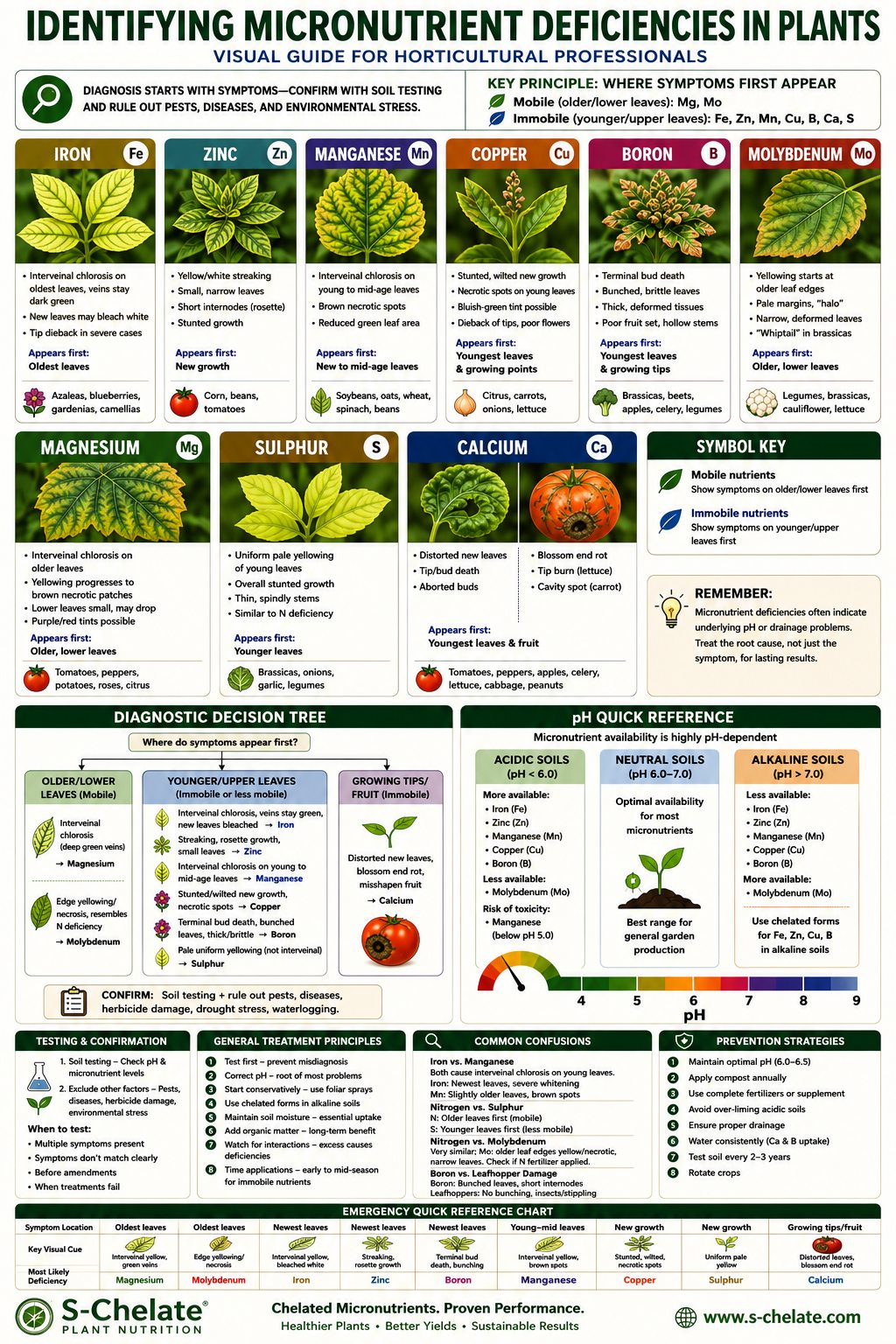

How to Use This Guide
This guide helps horticultural professionals identify micronutrient deficiencies through visual symptoms. Before diagnosing a deficiency, rule out other issues like pests, diseases, drought stress, or waterlogging, as these can mimic nutrient problems.
Key diagnostic principle: Where symptoms first appear tells you whether the nutrient is mobile or immobile in the plant:
- Mobile nutrients (show in older/lower leaves first): Magnesium, Molybdenum
- Immobile nutrients (show in younger/upper leaves first): Iron, Zinc, Manganese, Copper, Boron, Calcium, Sulphur
Iron (Fe) Deficiency
Visual Symptoms
- Interveinal chlorosis on youngest leaves – veins stay dark green while tissue between turns pale yellow or white [1, 10, 16]
- New shoots may die back from the tip
- In severe cases, entire new leaves turn bleached white [16, 17]
- Older leaves remain green initially
Where It Appears First
Youngest, emerging leaves (immobile nutrient) [26]
Common Causes
- High soil pH (above 7.0) – iron precipitates as iron hydroxide [10, 11, 13]
- Excessive phosphorus, zinc, or manganese competing for uptake [3, 14]
- Waterlogged or poorly drained soils [11, 16]
- Cold, wet spring conditions [11]
Most Susceptible Plants
Acid-loving plants: azaleas, rhododendrons, blueberries, gardenias, camellias
Treatment
- Immediate: Apply chelated iron (S-Chelate-O FE, organic supplement) as foliar spray or soil drench [13, 16]
- Long-term: Lower soil pH with sulphur amendments; improve drainage [11, 15]
- Test soil pH before treating
Zinc (Zn) Deficiency
Visual Symptoms
- Yellow or white streaking on leaves (not uniform across leaf width) [9]
- Interveinal chlorosis on younger leaves [1, 6]
- Shortened internodes creating rosette or bunched appearance [9]
- Small, narrow, distorted leaves (“little leaf”) [5]
- Stunted overall growth [5]
Where It Appears First
New growth and younger leaves (immobile nutrient) [26]
Common Causes
- High soil pH (above 7.0) [3, 9]
- High phosphorus levels [3]
- Cold, wet soil conditions in early season [5]
- Sandy soils with low organic matter [9]
- Over-liming [9]
Most Susceptible Plants
Corn, beans, tomatoes
Treatment
- Immediate: Foliar spray with zinc sulfate or chelated zinc (S-Chelate-O Zn, organic)
- Preventive: Apply zinc with starter fertiliser; use chelated forms (S-Chelate-O Zn) for alkaline soils
Manganese (Mn) Deficiency
Visual Symptoms
- Interveinal chlorosis on younger leaves first [1, 2, 10]
- Yellow tissue between veins while veins remain green [6]
- Brown, necrotic spots may develop as deficiency progresses [3]
- Reduced green leaf area
- Similar to iron deficiency but appears on slightly older leaves [1]
Where It Appears First
New to middle-aged leaves (immobile nutrient) [26]
Common Causes
- High soil pH (above 7.0) [2, 3, 10]
- Excessive iron or calcium [3]
- Well-aerated, high organic matter soils [2]
- Over liming [2]
Most Susceptible Plants
Soybeans, oats, wheat, spinach, beans [2]
Treatment
- Immediate: Foliar application of S-Chelate-O Mn, organic [2]
- Apply in late vegetative stages; can repeat if needed
- Lower soil pH if consistently alkaline
- Tissue testing recommended as symptoms mimic other deficiencies [6]
Note: Very acidic soils (pH below 5) can cause manganese toxicity, showing as necrotic leaf edges [3]
Copper (Cu) Deficiency
Visual Symptoms
- Stunted or wilted appearance in new growth
- New leaves show necrotic spots
- Bluish-green leaf tint possible
- Interveinal chlorosis on newer leaves
- Dieback of terminal buds and growing tips
- Delayed maturity
- Mature leaves may drop prematurely
- Poor flower development
Where It Appears First
Youngest leaves and growing points (immobile nutrient)
Common Causes
- Sandy soils with low organic matter
- Incorrect pH (too alkaline)
- Excessive phosphorus or iron levels
- Peat-based growing media
Most Susceptible Plants
Citrus, carrots, onions, lettuce, spinach
Treatment
- Immediate: Apply S-Chelate-O Cu as foliar spray
- Start with foliar application to avoid toxicity risk
- Correct pH before treatment
- NB Copper is needed in very small amounts – excess causes toxicity
Boron (B) Deficiency
Visual Symptoms
- Terminal bud death followed by excessive lateral branching [2, 5, 9]
- Yellow-reddish colour on new leaves while older leaves stay green
- Chlorotic or distorted young leaves
- Bunched leaves with shortened internodes [26]
- Thick, brittle leaves [26]
- Brown cracks in stems (celery, broccoli)
- Hollow stems in brassicas
- Corking on upper leaf surfaces
- Poor fruit set; internal fruit damage (core rot in apples, hollow heart in vegetables) [2]
Where It Appears First
Youngest leaves and growing tips (immobile nutrient – requires continuous supply)
Common Causes
- Alkaline soils (pH above 7.0)
- Sandy, low organic matter soils
- Drought conditions
- Excessive liming
- Low soil moisture
Most Susceptible Plants
Brassicas (broccoli, cauliflower, cabbage), beets, turnips, celery, apples, alfalfa, legumes
Treatment
- Immediate: Apply S-Chelate-O B to soil or boric acid to foliage
- Caution: Narrow range between deficiency and toxicity – follow label rates carefully
- Better to apply to soil than foliage to avoid leaf burn
- Ensure consistent moisture for uptake
- Test soil pH; avoid over-liming
Note: Can be confused with leafhopper damage; boron causes bunched leaves, leafhoppers don’t
Molybdenum (Mo) Deficiency
Visual Symptoms
- Symptoms resemble nitrogen deficiency but occur with adequate N [5, 9]
- Mottled yellow colour starting at older leaf edges [9]
- Pale green to yellow “halo-ing” on leaf margins
- Rest of foliage light green
- Necrotic leaf edges in advanced stages
- Narrow, deformed, or elongated leaves
- “Whiptail” in cauliflower/brassicas – misshapen central leaves [9]
- Stunted growth
- Poor flower development
Where It Appears First
Older, lower leaves (mobile nutrient) [26]
Common Causes
- Acidic soils (pH below 5.5) – most common cause [2, 9, 10]
- Unlike most micronutrients, molybdenum becomes MORE available as pH rises [2, 10]
- Nutrient imbalances
- Low soil levels in sandy areas
Most Susceptible Plants
Legumes (needs molybdenum for nitrogen fixation), brassicas, cauliflower, lettuce, tomatoes, African violets [5, 9]
Treatment
- Immediate: Flush system with pH-balanced water; apply molybdenum-containing fertiliser
- Foliar spray with sodium molybdate [9]
- Long-term: Raise soil pH with lime (opposite of most micronutrients) [2, 10]
- Needed in extremely small amounts – careful application required
- Address before planting legumes to ensure nitrogen fixation [5]
S-Chelate Cultiv-8 and S-Chelate-O 7 Element contain Molybdenum
Magnesium (Mg) Deficiency
Visual Symptoms
- Interveinal chlorosis on older leaves first
- Deep green veins with yellow areas between
- Yellowing advances to necrotic brown patches
- Lower leaves become small and may drop
- Purple or red tints possible on some species
- Leaves may become brittle or thin
Where It Appears First
Older, lower leaves (mobile nutrient)
Common Causes
- Sandy, acidic soils (easily leached)
- Excessive potassium, calcium, or sodium competing for uptake
- High rainfall washing magnesium from soil
- Container plants after several months without feeding
Most Susceptible Plants
Tomatoes, peppers, potatoes, roses, citrus, apples
Treatment
- Immediate: Apply S-Chelate-O Mg as foliar spray or soil application
- Dolomitic limestone for long-term correction (adds both calcium and magnesium)
- Apply at least every 3 months if deficiency persists
- Ideal Ca:Mg ratio is at least 2:1
Sulphur (S) Deficiency
Visual Symptoms
- Pale green to yellow younger leaves (unlike nitrogen, which affects older leaves)
- Overall stunted growth
- Thin, spindly stems
- Similar to nitrogen deficiency but starts on new growth
- Uniform chlorosis rather than interveinal
Where It Appears First
Younger leaves (relatively immobile)
Common Causes
- Sandy soils with low organic matter
- Low rainfall areas
- Reduced atmospheric sulphur deposition
- High-yield cropping without replacement
Most Susceptible Plants
Brassicas (cabbage family), onions, garlic, legumes
Treatment
- Apply sulphur-containing fertilisers: S-Chelate Cultiv-8, ammonium sulfate, gypsum, or elemental sulphur
- Incorporate organic matter
- Use sulfate forms of other nutrients when possible
Calcium (Ca) Deficiency
Visual Symptoms
- Distorted new growth – curled, cupped, or malformed young leaves [1, 20]
- Necrotic patches on newest leaves
- Growing tip death
- Blossom end rot on tomatoes, peppers, squash [16, 17, 18, 19, 21, 22, 23, 24]
- Tip burn on lettuce
- Cavity spot in carrots
- Black heart in celery
- Misshapen fruit
- Aborted buds
Where It Appears First
Youngest leaves and fruit (immobile nutrient) [26]
Common Causes
- NOT always low soil calcium – often inadequate water uptake and transport [16, 17, 18, 19, 21]
- Drought stress preventing calcium movement [17, 21, 22, 23]
- Rapid fruit growth [22]
- High humidity reducing transpiration [24]
- Excessive potassium, magnesium, or sodium [17, 18]
- Acidic, sandy soils (true deficiency) [17, 22]
Most Susceptible Plants
Tomatoes, peppers, apples, celery, lettuce, cabbage, peanuts [16, 17, 21, 22]
Treatment
- First: Ensure consistent soil moisture – irregular watering is often the real cause [16, 17, 18, 21, 22, 23, 24]
- Apply S-Chelate Ca if soil testing confirms low calcium [17, 22]
- Foliar sprays less effective for calcium [18, 22, 23]
- Maintain proper Ca:Mg ratio (2:1 or higher)
- Avoid over-fertilising with potassium [17, 24]
S-Chelate 12 Star and S-Chelate Protom both contain calcium
Diagnostic Decision Tree
Step 1: Where do symptoms appear first?
OLDER/LOWER LEAVES:
- Interveinal chlorosis with deep green veins → Magnesium
- Yellowing at leaf edges, resembles N deficiency → Molybdenum
YOUNGER/UPPER LEAVES:
- Interveinal chlorosis, veins stay green, new leaves bleached → Iron
- Streaking, rosette growth, small leaves → Zinc
- Interveinal chlorosis on mid-age to young leaves → Manganese
- Stunted/wilted new growth, necrotic spots → Copper
- Terminal bud death, bunched leaves, thick/brittle texture → Boron
- Pale uniform yellowing (not interveinal) → Sulphur
GROWING TIPS/FRUIT:
- Distorted new leaves, blossom end rot → Calcium
pH Quick Reference
Micronutrient availability is highly pH-dependent [3, 7, 10]:
Acidic Soils (pH < 6.0)
- More available: Iron, zinc, manganese, copper, boron [7, 10]
- Less available: Molybdenum [2, 10]
- Risk of toxicity: Manganese (below pH 5.0) [3, 10]
Neutral Soils (pH 6.0-7.0)
- Optimal availability for most micronutrients [7, 10]
- Best range for general garden production
Alkaline Soils (pH > 7.0)
- Less available: Iron, zinc, manganese, copper, boron [3, 10, 11, 13]
- More available: Molybdenum [2, 10]
- Use S-Chelate chelated forms for iron, zinc, copper [13, 16]
Testing and Confirmation
Visual diagnosis is a starting point, but for accurate identification [1, 6, 10]:
- Soil testing – Check pH and micronutrient levels before treating [1, 4, 6, 7]
- Exclude other factors – Rule out pests, diseases, herbicide damage, environmental stress [6]
When to Test
- Multiple deficiency symptoms present
- Symptoms don’t match any single nutrient clearly
- Before applying expensive or potentially toxic amendments
- When treatment attempts fail
General Treatment Principles
- Test first – Soil and/or tissue analysis prevents misdiagnosis
- Correct pH – Most micronutrient problems stem from wrong pH
- Start conservatively – Foliar applications allow precise control
- Use chelated forms especially in alkaline soils for iron, zinc, copper
- Maintain soil moisture – Essential for nutrient uptake
- Add organic matter – Improves long-term nutrient availability
- Watch for interactions – Excess of one nutrient can induce deficiency of another
- Time applications appropriately – Early to mid-season for immobile nutrients
Common Confusions
Iron vs. Manganese
- Both cause interveinal chlorosis on young leaves
- Iron: Newest leaves most affected, more severe whitening
- Manganese: Slightly older leaves, brown spots develop
Nitrogen vs. Sulphur
- Both cause overall yellowing
- Nitrogen: Older leaves yellow first (mobile)
- Sulphur: Younger leaves affected (less mobile)
Nitrogen vs. Molybdenum
- Very similar symptoms
- Molybdenum: Older leaf edges yellow/necrotic, narrow leaves
- Check if nitrogen fertiliser has been applied
Boron vs. Leafhopper Damage
- Both cause distorted growth
- Boron: Bunched leaves, shortened internodes
- Leafhoppers: No bunching, visible insects/stippling
Prevention Strategies
- Maintain optimal pH (6.0-6.5 for most vegetables and ornamentals)
- Apply compost annually (slow-release micronutrient source)
- Use complete fertilisers that include micronutrients or supplement standard manures and fertilisers with micronutrients
- Avoid over-liming acidic soils
- Ensure proper drainage to prevent nutrient lockout
- Water consistently for calcium and boron uptake
- Test soil every 2-3 years to track nutrient trends
- Rotate crops to avoid depleting specific nutrients
Emergency Quick Reference Chart
| Symptom Location | Key Visual Cue | Most Likely Deficiency |
|---|---|---|
| Oldest leaves | Interveinal yellow, green veins | Magnesium |
| Oldest leaves | Edge yellowing/necrosis | Molybdenum |
| Newest leaves | Interveinal yellow, bleached white | Iron |
| Newest leaves | Streaking, rosette growth | Zinc |
| Newest leaves | Terminal bud death, bunching | Boron |
| Young-mid leaves | Interveinal yellow, brown spots | Manganese |
| New growth | Stunted, wilted, necrotic spots | Copper |
| New growth | Uniform pale yellow | Sulphur |
| Growing tips/fruit | Distorted leaves, blossom end rot | Calcium |
Remember: Micronutrient deficiencies often indicate underlying pH or drainage problems. Treat the root cause, not just the symptom, for lasting results.
References and Sources
This guide was developed using information from the following authoritative sources:
University Extension Publications
- Shober, A.L. and Denny, G.C. (2025). “Identifying Nutrient Deficiencies in Ornamental Plants.” University of Delaware Cooperative Extension. https://www.udel.edu/academics/colleges/canr/cooperative-extension/fact-sheets/identifying-nutrient-deficiencies-in-ornamental-plants/
- University of Minnesota Extension (2025). “Micro- and Secondary Macronutrients.” UMN Extension Nutrient Management. https://extension.umn.edu/nutrient-management/micro-and-secondary-macronutrients
- Montana State University Extension. “Nutrient Management: Plant Nutrient Functions and Deficiency and Toxicity Symptoms.” MSU Extension Publication 4449-9. https://apps.msuextension.org/publications/pub.html?sku=4449-9
- University of Maryland Extension. “Nutrient Deficiency of Vegetable Plants.” https://extension.umd.edu/resource/nutrient-deficiency-vegetable-plants
- Purdue University Extension (AY-239). “Micronutrients for Indiana Field Crops.” https://www.extension.purdue.edu/extmedia/ay/ay-239.html
- Wollaeger, H. (MSU Extension). “Six Steps to Identifying Nutrient Deficiencies in Ornamental Plants.” Michigan State University Extension. https://www.canr.msu.edu/news/six_steps_to_identifying_nutrient_deficiencies_in_ornamental_plants
- University of Florida IFAS Extension (2022). “Plant Essential Nutrients and Their Role.” SS-AGR-463/AG462. https://edis.ifas.ufl.edu/publication/AG462
- University of Arizona Cooperative Extension. “Guide to Symptoms of Plant Nutrient Deficiencies.” https://extension.arizona.edu/publication/guide-symptoms-plant-nutrient-deficiencies
- Oldham, L. and Jones, K.D. (Mississippi State University Extension). “Micronutrients in Mississippi Soils and Plant Nutrition.” https://extension.msstate.edu/publications/micronutrients-mississippi-soils-and-plant-nutrition
Iron Deficiency Chlorosis – Specific Resources
- Utah State University Forestry Extension. “What is Iron Chlorosis and What Causes it?” https://extension.usu.edu/forestry/trees-cities-towns/tree-care/causes-iron-chlorosis
- Goldberg, N.P. (NMSU Extension). “Iron Chlorosis.” New Mexico State University Extension Publication H-171. https://pubs.nmsu.edu/_h/H171/index.html
- University of Minnesota Extension. “Managing Iron Deficiency Chlorosis in Soybean.” https://extension.umn.edu/crop-specific-needs/managing-iron-deficiency-chlorosis-soybean
- Kansas State University Extension. “Managing Iron Deficiency Chlorosis in Sorghum.” https://eupdate.agronomy.ksu.edu/article/managing-iron-deficiency-chlorosis-in-sorghum-640-1
- Harden, G. (Utah State University Extension, 2020). “Ask an Expert – Iron Chlorosis: Symptoms, Causes and Solutions.” https://www.usu.edu/today/story/ask-an-expert—iron-chlorosis-symptoms-causes-and-solutions
- Washington State University Extension. “Common Cultural: Nutrient Deficiency.” HortSense. https://hortsense.cahnrs.wsu.edu/fact-sheet/common-cultural-nutrient-deficiency/
Calcium and Blossom End Rot Resources
- University of Connecticut Home & Garden Education Center (2025). “Put an End to Blossom-End Rot: Water and Nutrient Management is Key.” https://homegarden.cahnr.uconn.edu/2025/06/15/blossom-end-rot/
- Kemble, J. and Sikora, E. (Auburn University, 2024). “Blossom-End Rot in Tomatoes: Causes and Prevention.” Alabama Cooperative Extension System, ANR-1059. https://www.aces.edu/blog/topics/lawn-garden/blossom-end-rot-in-tomatoes-causes-and-prevention/
- Michigan State University Extension. “Blossom-end Rot of Tomato Tip Sheet.” https://www.canr.msu.edu/resources/blossom_end_rot_tip_sheet
- University of Wisconsin Horticulture. “Blossom End Rot.” Wisconsin Horticulture Division of Extension. https://hort.extension.wisc.edu/articles/blossom-end-rot/
- Gardener’s Supply Company (2025). “Prevent Blossom-End Rot: Tomato Diseases and Problems.” https://www.gardeners.com/how-to/blossom-end-rot/5354.html
- The Old Farmer’s Almanac (2025). “Blossom-End Rot: Preventing Blossom-End Rot on Tomatoes & Other Vegetables.” https://www.almanac.com/pest/blossom-end-rot
- Iowa State University Extension (Small Farm Sustainability). “Managing Blossom End Rot in Tomatoes and Peppers.” https://www.extension.iastate.edu/smallfarms/managing-blossom-end-rot-tomatoes-and-peppers
- Pacific Northwest Pest Management Handbooks (2025). “Tomato (Solanum lycopersicum)-Blossom-end Rot.” https://pnwhandbooks.org/plantdisease/host-disease/tomato-solanum-lycopersicum-blossom-end-rot
- University of California Cooperative Extension, Butte County Master Gardeners (2025). “Fighting Blossom End Rot.” The Real Dirt. https://ucanr.edu/blog/real-dirt/article/fighting-blossom-end-rot
- Connecticut Agricultural Experiment Station. “Blossom-End Rot of Tomato.” https://portal.ct.gov/caes/fact-sheets/plant-pathology/blossom-end-rot-of-tomato
Peer-Reviewed Scientific Literature
- Lilay, G.H., Castro, P.H., Campilho, A., and Assunção, A.G.L. (2024). “Linking the key physiological functions of essential micronutrients to their deficiency symptoms in plants.” New Phytologist, 243(1). https://doi.org/10.1111/nph.19645
General Plant Nutrition Resources
- McCauley, A., Jones, C., and Jacobsen, J. (2009). “Plant Nutrient Functions and Deficiency and Toxicity Symptoms.” Montana State University Extension Service, Bozeman, MT.
Note on Information Currency
This guide synthesises established horticultural and agronomic knowledge about plant micronutrient deficiencies from university extension services and peer-reviewed scientific literature. The information reflects current best practices in plant nutrition diagnosis and management as of early 2025.